

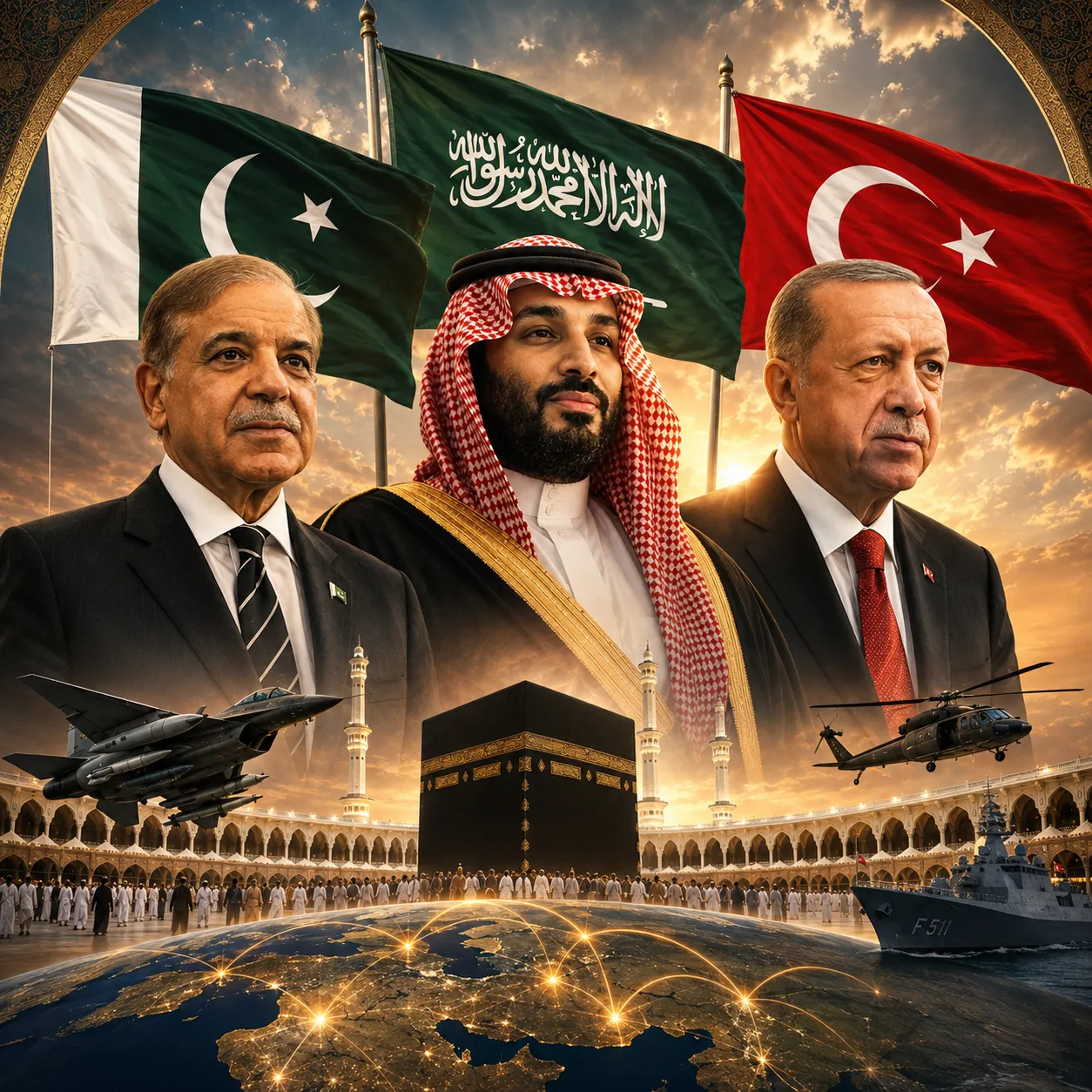
The signing of a historic joint defence pact in Makkah marks a new chapter in the longstanding partnership between Pakistan, Saudi Arabia and Türkiye. The agreement says that if an armed attack is launched against any of the three countries, it will be considered an attack against all three. The agreement was signed in front of Prime Minister Shehbaz Sharif, Saudi Crown Prince Mohammed bin Salman and Turkish President Recep Tayyip Erdoğan, and is one of the latest in a series of bilateral deals struck by the two nations.The Saudi and Turkish leaders, Mohammed bin Salman and Erdoğan, respectively, signed the pact in the presence of Prime Minister Shehbaz Sharif, while the Middle East and the surrounding region is beset with growing security threats.
The importance of the pact is not just that it's a defence pact. It is a sign of the deepening strategic partnership of three countries which have enjoyed close political, economic and military ties for decades. The Makkah agreement puts these relations on a firmer strategic footing through the collective security basis it provides.
The timing of the agreement is especially important. Security risks loom in Saudi Arabia, with armed groups active throughout the region and threats from missiles or drones launching attacks. The situation in Yemen is now more perilous with the fighting and the Houthis' many attacks being not only military but also civilian. However, the activities and presence of armed groups linked to Iran in the country and other parts of the world have been a point of worry for Gulf countries.
In this context, more robust defence relations have gathered greater significance for Riyadh. Pakistan and Türkiye present two important strategic partners that have significant military capabilities and experience in the region. Pakistan is a nuclear armed country with one of the most experienced and well-trained military forces in the region, and Türkiye has a wealth of defence expertise, high levels of military development and is a member of NATO.
The pact also holds great strategic and diplomatic value for Pakistan. Saudi Arabia is a long-standing ally and vital economic partner and the ties between Islamabad and Ankara have been steadily growing in defence, trade and diplomatic spheres. A trilateral security mechanism could give the opportunity to share information, to train together, to cooperate in the field of defence, and to take action together in the case of new threats.
The pact has also garnered interest from those other than the three signatories. The development has raised concerns in Iran, which is very sensitive about new defence pacts in an already volatile region. Turkish President Recep Tayyip Erdoğan, however, has said the settlement is not targeted at any country. This is important because any new security deal that any of the big powers in the region have is going to be seen in the broader context of the shifting strategic landscape of the Middle East.
The agreement also conveys a larger political message. The Prime Minister Shehbaz Sharif called it a ‘shield of peace and stability’ for future generations. In his remarks, he emphasizes the key concept of the agreement: the security of one partner is now seen as linked to the security of the other partners.
The location of Makkah further empowers the development. The city is also of considerable significance to the Muslim world, in addition to its political and strategic significance. By announcing a major security partnership there, it helps instill a symbolic dimension in the agreement, reinforcing the narrative of solidarity and cooperation between the three countries.
But the actual effectiveness of the Makkah Defence Agreement will depend on the extent to which it can be implemented in terms of cooperation. It's the actual signing that constitutes a political commitment, but the practical effects will be measured in terms of intelligence coordination, joint exercises, military training, defence production and the response to the threats.
The deal is a timely one given the rapidly changing regional alliances and security calculations. New configurations in the regional and international strategic landscape are created through conflicts, proxy confrontations, missile and drone threats, and changing relations between regional and global powers. A closer cooperation between Pakistan, Saudi Arabia and Türkiye in this regard may have an impact on the overall security framework of the region.
The very essence of the Makkah accord is that Pakistan, Saudi Arabia and Türkiye are aiming to go beyond the diplomatic friendship and establish a more formal cooperation in the context of shared security concerns. The next few years will show if this commitment is replaced in the future by a long-term strategy that will change regional security situation.
For now, the pact is a major milestone in the growing alliance of three powerful Muslim nations—and an affirmation that, in a volatile Middle East, powers will join forces when their security is threatened.


