

Yes, India is the world’s largest democracy, with its democratic record facing growing scrutiny.
Yes, India is one of the world’s fastest-growing major economies, even as growth remains uneven across society.
Yes, the Narendra Modi government has always been promoting India as an emerging global power – an economic power, a civilizational power that will lead the world.
But there is another story of India, one that doesn't feature prominently in the political photographs, or the glossy images from economic summits.
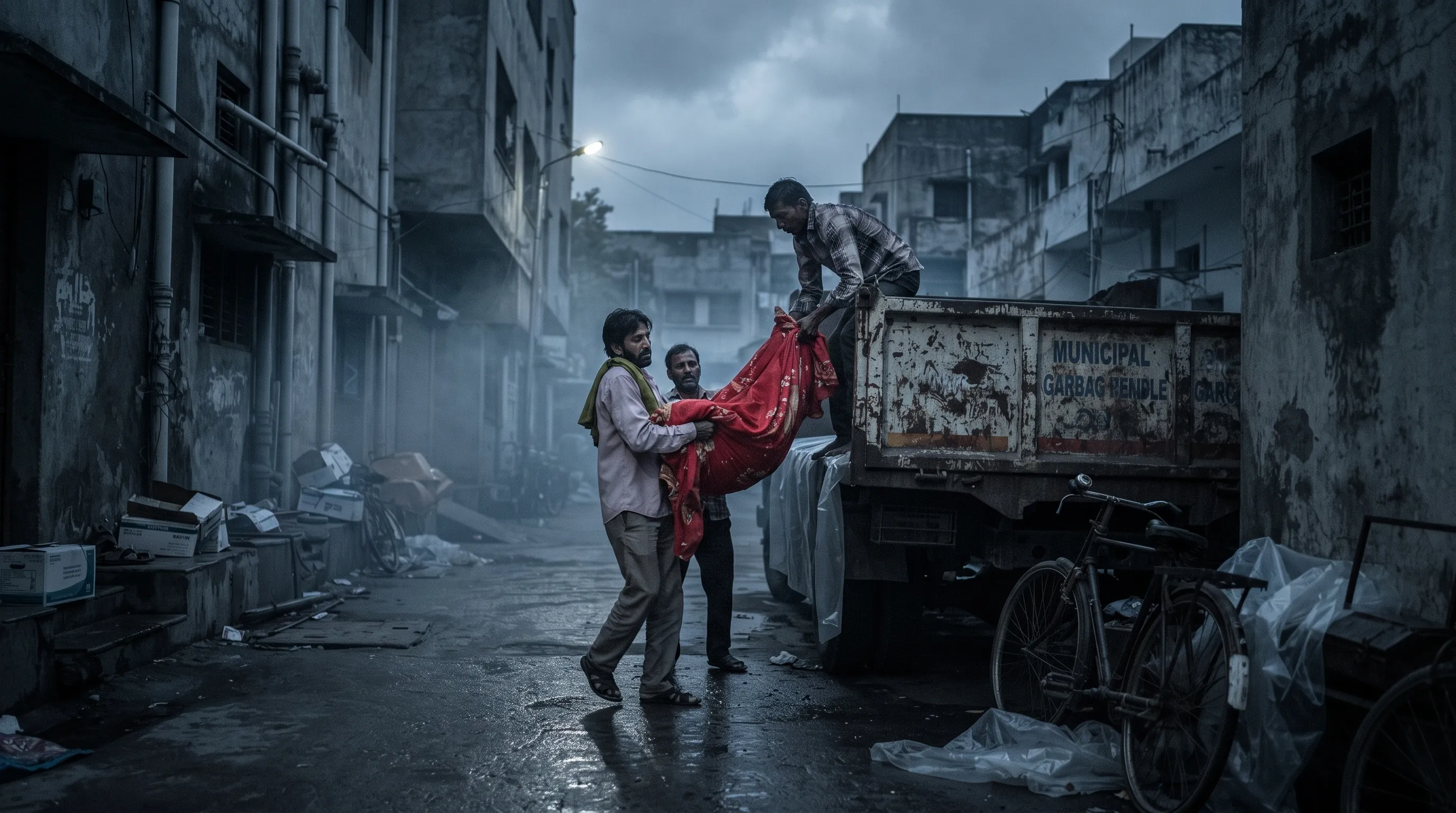
A woman's body was loaded onto a tractor-trolley that hauled garbage. The family had been trying to get the kind of mortuary van they needed for days, but hadn't raised the necessary money, officials said.
There couldn't be a more dramatic contrast! BJP's grand offices and big projects are constructed throughout the districts, but fundamental dignity in death is unattainable for the common people.
This picture is far from what one would imagine of a country looking for leadership in the world. If the ability to fire satellites, throw billions of dollars at infrastructure, and boast to the world that you're the third biggest economy is what's important, then perhaps it should also be judged on more pedestrian, but important, measures—the dignity you give to the people you put on your turf who are fighting for their lives in the game of life.
The incident is of political importance especially in light of the Bharatiya Janata Party government at both the state and central level in Madhya Pradesh, which is touted as the ‘double engine system'. The premise of this model is simple: unity of the political should ensure faster pace of development and better governance.
But common sense is not effectively shared through a common political allegiance. Government efficiency cannot be assumed where the same party is in power at more than one level. Real improvement should be seen in quality healthcare, sanitation, infrastructure, educational institutions, emergency services and in municipal governance. Empty slogans of economic growth are meaningless in the absence of basic public services.
Moreover, we need to question the growing "majoritarian" character of political debates in India. During the Hindutva era, civilizational identity, religious symbolism, nationalism and the cultural might of India are frequently highlighted. Political campaigns about identity can be effective - can make people feel like they belong and feel good about the nation - but they should never be a justification of the failure of government.
Citizens might be told that this country is on the path to becoming a Vishwaguru, but if their basic dignity is denied to their home when they're not even getting it, such promises are too heavy to bear. The presence of political symbols like temples or military exhibitions can lead to the successful creation of images, whereas the organization of world summits can contribute to the generation of sophistication does not mitigate the importance of local government.
This brings up an awkward question – why do Indians boast about their accomplishments? Economic progresses and technological developments of all countries should be recognized. But is the political story so strong that it drowns out the issues of our own culpability that need to be held accountable?
This is reflected in the Indian electoral situation. BJP has always been able to create a strong electoral alliance based on welfare, nationalism, leadership and the Hindu cultural identity. However, it's not just about the ignorance of voters. The party's appeal is based on a range of factors, such as economic hopes, nationalism, social welfare programs, ideology, charisma of party leaders, and dissatisfaction with the other political parties.
However, a government should not be allowed to evade criticism because it is popular at the polls. This is true for all democracies.
The tragedy in Madhya Pradesh isn't just about one image, or one city's shortcomings. It's about the nature of development.
Is development simply a function of economy's scale or is it a matter of dignity being given to the most vulnerable?
Does governmental success depend on the declaration of grand projects, or just on the effective operation of the essential services, particularly in times of crisis when households are most in need?
Is a country civilizing if its public services have been poor in quality in comparison to the modern standard?
India's rise on the global podium is indeed a reality but it has its own contradictions. Technology can be the pathway to progress, while providing a solution to the sanitation problem at the local level. It can be a source of significant foreign investment, while millions could still be on shaky public systems. Even while local institutions face challenges on which they are not expected to apply complex technologies or huge resources, India can lead on the global platform.
This paradox should be highlighted and not drowned out by the slogans about India's rise.
Not just the outward glee of citizens for the nation is an accurate expression of whether a state is democratic. It's about the quiet moments when no one's looking, when the effectiveness of the State is most clearly displayed.
Sometimes, the strongest condemnation of a government's priorities comes not in opposition speeches or international reports, but is captured in one striking image of a family placing their loved one in a garbage truck for burial.
When a citizen's final trip is in a garbage car because a mortuary car is too costly, the issue isn't whether or not a country can boast how great it is. The question is if that greatness has come to this people most in need.


